I developed this University of Melbourne research impact story in early 2023 for a defence and national security industry and government audience. It remained one of the top 5 most-viewed pieces of content on the Research website after its publication, including in Q3 2024 and Q2 2025. It was also published in the Defence Science and Technology OUTLOOK 2023 (page 35).
Better situational awareness means control – and improved safety of personnel. Quantum sensors using deliberately flawed diamonds can render the ground transparent to enable visualising, tracking, and classifying of objects that are underground.
Developed by a team of academics at the University of Melbourne and RMIT University, working with industry and engineers from Phasor Innovation, quantum diamond magnetometers can sense the direction and strength of very weak magnetic fields.
The Quantum Diamond Magnetometry team are exploring ways to use these sensors in navigation, underground and undersea sensing, aerospace, the space domain, and healthcare.
Diamond defects create delicate quantum sensors
At the forefront of the current quantum technology revolution is an ancient material: diamond.
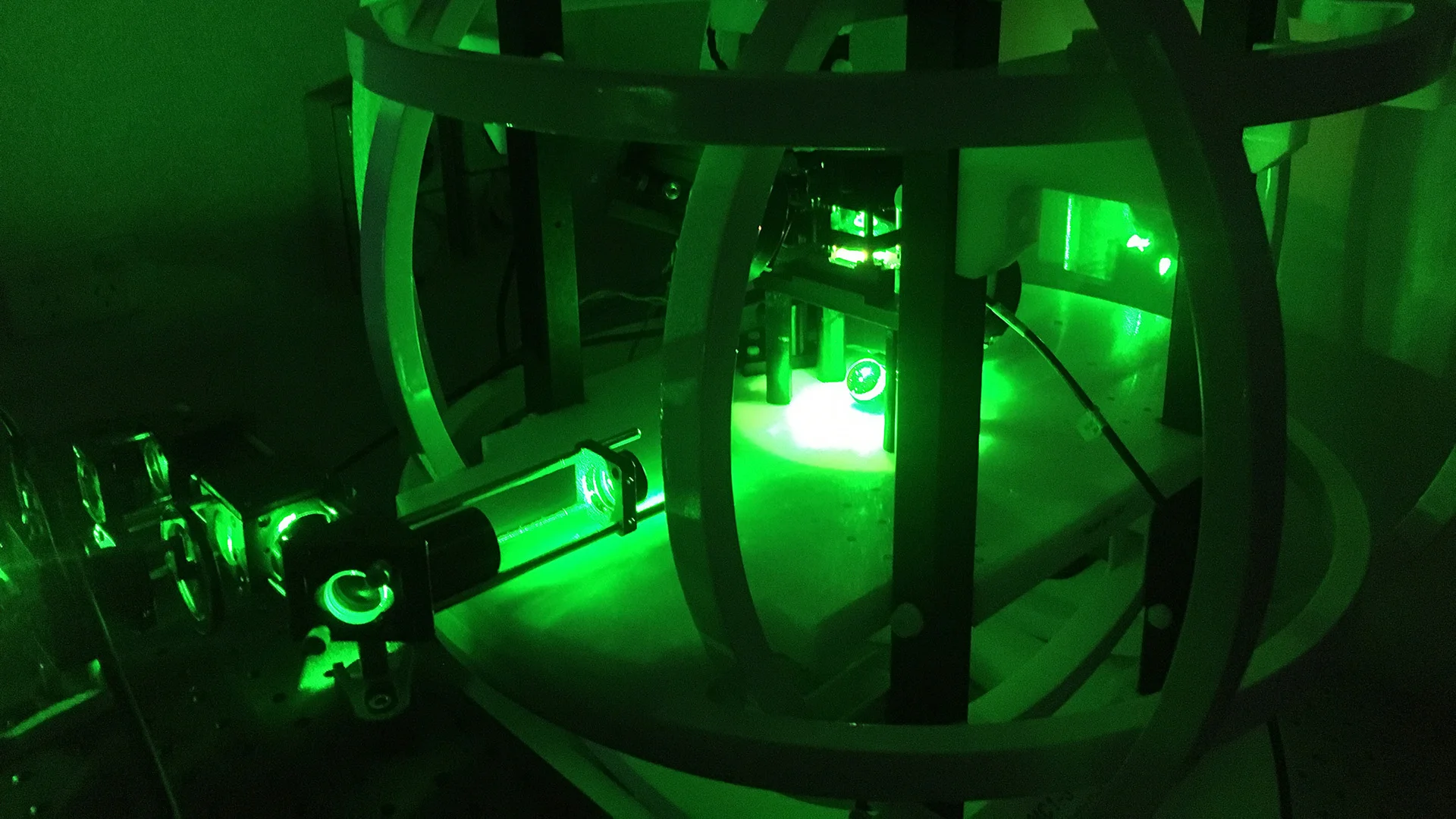
Pure diamond is made from carbon atoms arranged in an orderly crystal lattice. Disrupting this lattice on the atomic scale by switching individual carbon atoms with nitrogen atoms transforms diamond from a coveted jewel into a delicate quantum sensor. Tiny changes in the environment, such as variations in magnetic fields, alter the quantum mechanical properties of the defect centres. The changes in the quantum mechanical properties are conveniently detected by changes in fluorescent light emitted by the defect centres.
“Diamond quantum sensors are unique in that they can operate at room temperature in ambient unshielded conditions and with sensitivities that surpass their classical counterparts,” says Associate Professor David Simpson, a University of Melbourne researcher in the School of Physics.
Superconducting quantum interference devices and optically pumped magnetometers are complementary quantum sensors for detecting magnetic fields. However, they are often constrained in terms of cost, size, dynamic range, and operating temperature. Diamond quantum sensors do not suffer from these limitations and can operate under extreme environmental conditions.